Digital Textile Printer Models for Fabric Production
Hongsam supplies Hong-Jet® digital textile printers alongside the inks that run them, for fabric producers working roll to roll. Founded in 2001 and based in Zhengzhou, Henan, the company develops the ink and the machine side of fabric printing.
- Founded
- 2001
- Employees
- 301–500
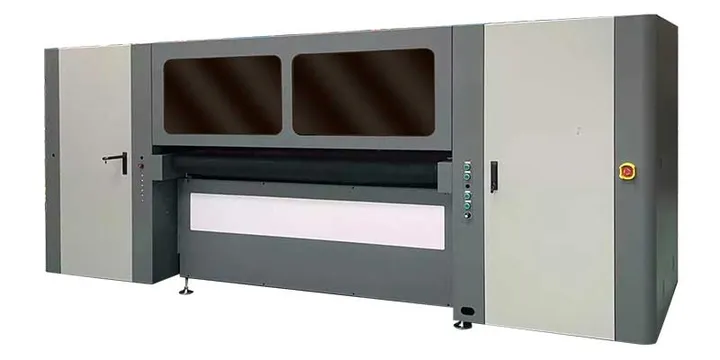
Digital Textile Printer Buying Guide
Choosing a digital textile printer starts with the fabric and the ink chemistry it needs, not with the machine size. Match the fibre and construction to a pigment, disperse, reactive, acid or sublimation route, then set print width and resolution from the artwork and the roll widths you actually run. Speed and roll-to-roll handling decide how the machine fits your shift pattern.
- Fabric type and preparation: how the cloth is scoured, heat-set or pre-treated before printing.
- Ink chemistry: pigment, disperse, reactive, acid or sublimation, each with its own fixation route.
- Print width, resolution and speed against your artwork detail and daily fabric volume.
- Roll-to-roll handling: unwinder, tension control, fabric guide and take-up.
- RIP workflow: colour profiles, repeat setting and job nesting.
- Maintenance access: daily capping, wiping and nozzle checks.
Compare the listed Hong-Jet® model specifications against those factors; widths and printhead counts are stated per model rather than for the range as a whole. Send your fabric samples and production requirements — fabric type, roll width, artwork and output target — and Hongsam will run a test print and prepare a quotation. Contact Hongsam to start that process.
Fabric Printer Configurations for Roll-to-Roll Production
A fabric printer built for roll-to-roll work is specified around the widest fabric you need to run and the number of printheads that fits your output. Printhead count sets the colour set and the number of passes a job needs; width sets how many panels or repeats fit across the roll.
The HJ models run from 1.8m to 3.2m, with 32 printheads on the HJ-1832A and 64 printheads on the HJ-1864A, HJ-2264A, HJ-2664A and HJ-3264A; the HJ-D2664B is listed at 2.6m with 64~128 printheads.
What to Check in a Fabric Printing Machine
Before ordering a fabric printing machine, confirm that the ink you intend to use is listed for that machine, and that the fabric arrives in the state the process expects — scoured, heat-set or pre-treated as the ink route requires. Check that the quoted print width matches your roll widths, and that resolution and speed match the detail you sell.
- Ink compatibility for the fabric and the fixation route.
- Print width against your roll widths and repeat sizes.
- RIP software and colour profile workflow.
- Maintenance access around the carriage and capping station.
- Power supply: the textile printing and dyeing integrated machine lists 380v/50Hz.
- Floor space: the fabric foil printer lists 4100*1500*1650mm (L * W * H).
Which checks apply depends on the exact Hongsam model. Power supply, floor space and width are stated per machine, and ink compatibility is listed per product rather than across the whole range, so a specification that applies to one machine does not carry over to another.
Textile Printing Machine Ink and Fabric Compatibility
A textile printing machine matches ink chemistry to fibre. Pigment inks sit on the surface and suit blends; reactive inks bond to cotton, linen and other cellulosics; acid inks suit silk and nylon; disperse inks suit polyester. Each route carries its own preparation and fixation steps, so machine, ink and finishing are chosen together.
The textile printing and dyeing integrated machine is compatible with textile pigment ink, disperse ink, reactive ink and acid ink, and with cotton, linen, silk, nylon, woven fabrics and knitted fabrics. Those lists belong to that machine; other Hongsam printers carry their own ink and fabric statements.
Hongsam developed RCT™ printing technology, which needs no pre-treatment or post-treatment.
Fabric Digital Printer Models and Print Widths
Fabric digital printer models differ mainly in width and printhead count. Width decides the largest fabric panel or the number of repeats you can lay across the roll; printhead count decides how many colour channels run at once and how the carriage is populated.
- HJ-1832A: 1.8m with 32 printheads.
- HJ-1864A: 1.8m with 64 printheads.
- HJ-2264A: 2.2m with 64 printheads.
- HJ-2664A: 2.6m with 64 printheads.
- HJ-3264A: 3.2m with 64 printheads.
- HJ-D2664B: 2.6m with 64~128 printheads.
Use the listed width to plan roll handling and the listed printhead count to plan colour configuration and job scheduling. A wider machine with more printheads is planned for higher volume per pass; a narrower one keeps short runs and small rolls practical.
Inkjet Fabric Printer Printhead and Maintenance Factors
In an inkjet fabric printer, printhead type sets which ink chemistry you can run, the resolution you can reach and the maintenance routine around it. Piezoelectric printheads are driven by waveform settings that belong to the ink, so printhead and ink are evaluated as one pair rather than separately.
The fabric foil printer is listed with 8*Epson I3200 printheads and an Epson i3200-A1 printhead, at resolutions of 720x1200dpi / 720x1080dpi / 720x2400dpi. Those figures apply to that model only; other machines in the Hongsam range come with their own printhead configuration.
Maintenance planning covers daily nozzle checks, capping and wiping, ink supply handling and waste path cleaning. Fabric lint is the usual cause of interrupted output, so a routine that clears the head surface and the media path before each long run keeps production predictable.
Digital Fabric Printer Applications: Clothing, Home Textiles, Outdoor
A digital fabric printer covers clothing and fashion, home textiles and the outdoor field. The textile printing and dyeing integrated machine lists those key application fields, with fabric compatibility spanning cotton, linen, silk, nylon, woven fabrics and knitted fabrics.
Polyester work sits with a different machine. The fabric foil printer uses different kinds of polyester fabrics as printing materials, and Hongsam supplies a Digital Foil Stamping Printer for Polyester Fabrics for designs that combine print with foil.
Alongside these machines, Hongsam lists a High Efficiency Garment Printing Solution for garment production, so a buyer can plan a cutting, printing and finishing sequence around the fabric they run most.
Fabric Inkjet Printer Software, Media, and Installation
RIP software turns artwork into print data: it applies the colour profile, sets ink limits, builds repeats for the fabric width and nests jobs on the roll. Media feed and fabric tension then decide whether the printed repeat stays square along the cloth.
The textile printing and dyeing integrated machine lists NeoStampa RIP software, which is compatible with the textile industry, and the fabric foil printer lists RIIN. Colour profiles and feed settings are built per machine and per fabric, so they are set up together with the ink.
Operator workflow matters as much as the software: a consistent pre-print check of nozzle condition, fabric alignment and profile selection keeps output repeatable across shifts, and roll handling at the unwinder and take-up protects tension through long runs.
Sublimation Fabric Printer Process and Use Cases
A sublimation printer suits polyester and polymer-coated fabrics. Disperse inks turn to gas under heat and bond into the polymer, so colour sits inside the fibre rather than on top of it. Transfer through a paper carrier is the common route, with direct-to-fabric as the alternative.
Compare it with the other routes: pigment sits on the surface and suits many fibre types, reactive inks bond to cotton and other cellulosics, and acid inks suit silk and nylon. Sublimation leaves no binder film on polyester, but it is limited to polymer-based fabrics.
The fabric foil printer uses different kinds of polyester fabrics as printing materials, so polyester work that pairs colour with foil effects sits within that machine’s listed scope, while cotton and blended work belongs with the pigment, reactive or acid routes.
Request a quotation
Send your print width, substrate and daily output; we will propose a matching model and ink set.
Or write to sales@inkjetinksupplier.com